
What to remember
- AI visibility starts with pages that are useful and understandable.
- Make claims supportable, attributable and easy to cite.
- Keep important facts consistent across the site and external profiles.
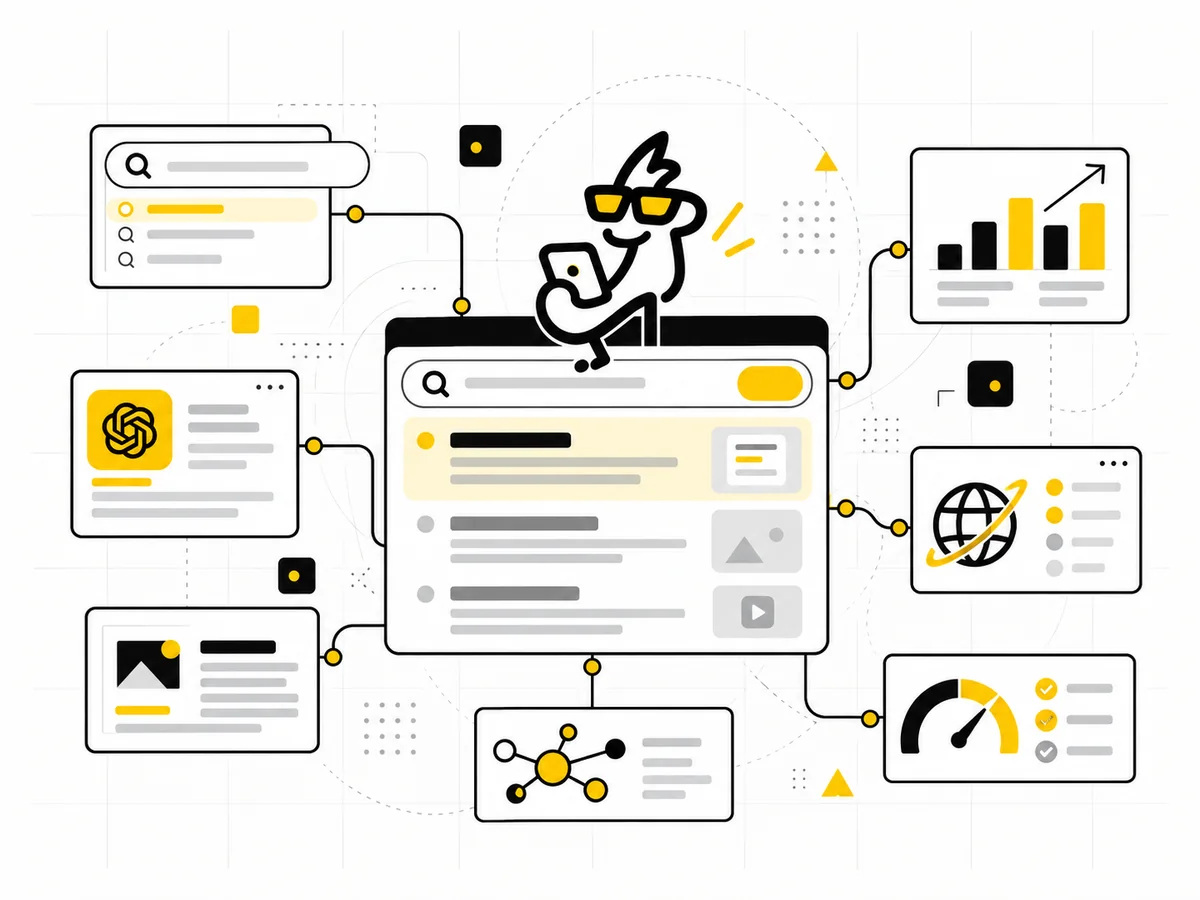
Make the organization explicit
Use a clear About page, consistent business name, contact details and service descriptions. Organization structured data can help search systems understand administrative details, but the visible page content still needs to match.
Create answerable pages
Use direct definitions and concise answers early, then add nuance, examples, process and evidence. Avoid padding simple questions with thousands of generic words.
Publish original evidence
Experiments, case studies, benchmarks, screenshots, methodology and first-party observations give other systems something distinctive to reference. Clearly label sample work so trust is not sacrificed for appearance.
Build expert and page-level trust
Show authorship or organizational ownership, update dates where relevant, link to primary sources and keep important URLs stable.
Connect the site internally
Service pages should link to useful articles. Articles should link back to relevant services. Related topics should be connected with descriptive anchor text so users and crawlers can follow the knowledge structure.
Build a small library of pages worth citing
Start with the questions prospects repeatedly ask before buying. Create a durable page for each high-value topic and make the answer useful even if the reader never contacts you. Add examples, methodology, limitations and links to related pages.
Over time, improve the strongest pages with first-party evidence: audit findings, anonymized patterns, original frameworks or real case studies when permission exists. This creates information competitors cannot reproduce by simply prompting the same language model.
AI visibility checklist
- Organization details are consistent across the site.
- About and service pages clearly explain expertise.
- Important answers live on stable crawlable URLs.
- Articles show ownership and update dates.
- Primary sources are linked when claims depend on them.
- Structured data matches visible content.
- Search and referral traffic are measured without treating AI citations as guaranteed.
Citation-ready page checklist
Answer the core question early.
Explain when the answer applies and when it does not.
Use examples, sources, methodology or first-party proof.
Make the responsible organization or author clear.
Show dates when recency matters.
Use descriptive headings and stable internal links.
Example: service information that is easier to understand
A page titled only “Solutions” gives weak context. A clearly named page such as “SEO + AI Search Visibility” can explain the problem, outcomes, process, limitations and related expertise. The goal is not to manipulate AI systems; it is to remove ambiguity for people and machines.
Google Search Central: people-first content · Google Search Central: search appearance
Frequently asked questions
Is there special AI schema we need?
There is no magic markup that guarantees AI inclusion. Use accurate structured data types that describe the organization and content.
Should we create content only for AI search?
Create content for real user questions first, then structure it so search and AI systems can understand it cleanly.